
🔨 Planned for T2. Builds on Phase 2’s BLS-only auth model.
Lands the agent-account model and dispute-handling paths on testnet,
plus the multi-key
BLSKeyRegistry upgrade.Architecture diagram
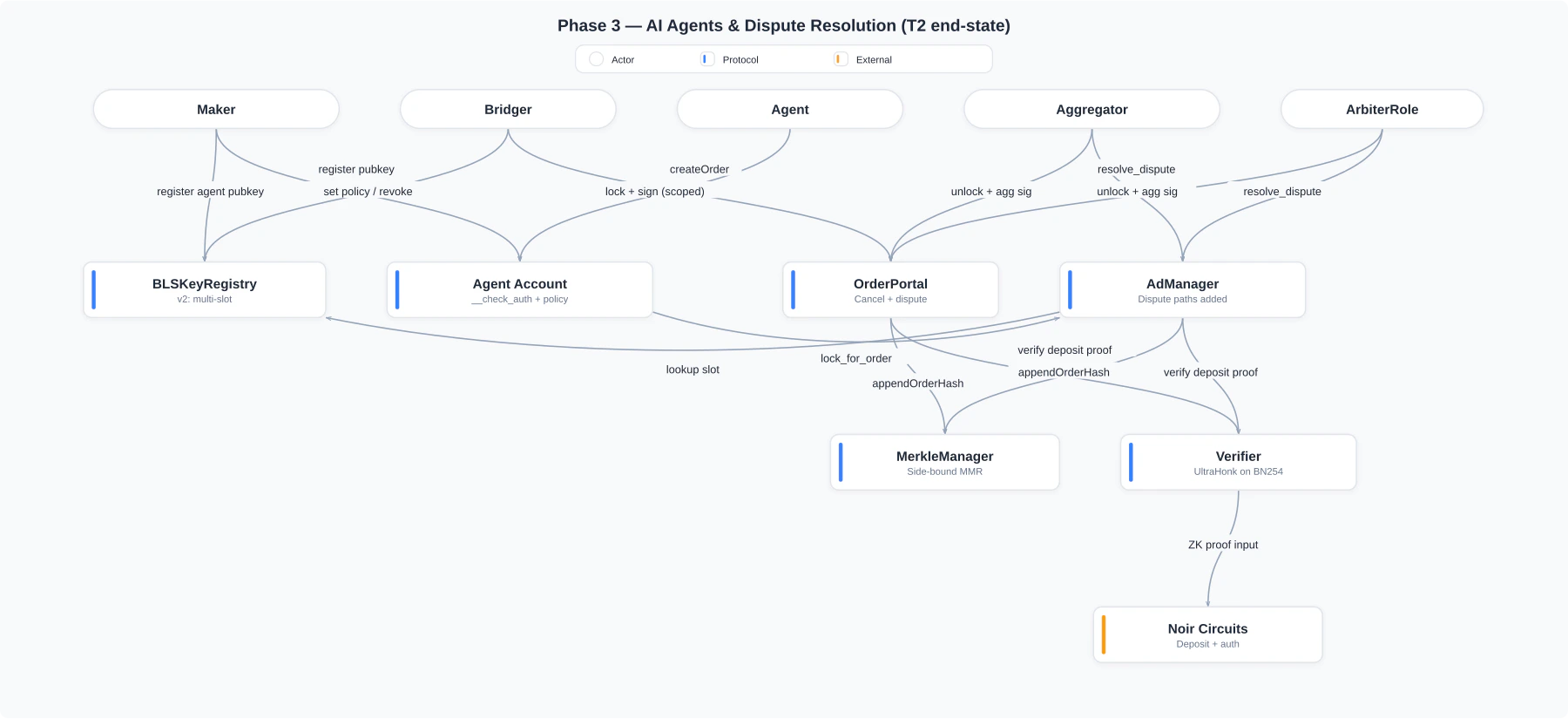
Delta from Phase 2
What changes vs Phase 2:Agent Account (Soroban + EVM)
Maker deploys their own contract — Soroban custom account with
__check_auth, or per-maker Safe Module on EVM. Stores a policy
table per agent (allowed actions, token whitelist, per-order cap,
rate limit, expiry, revocation flag).Multi-key `BLSKeyRegistry` v2
Replaces Phase 2’s single-key registry. Each address can hold up
to 5 active key slots with stable monotonic IDs and a
valid_until
timestamp per slot. unlock takes a slot hint so pairing-check
cost stays at one attempt.`OrderData` gains `deadline`
The
Order struct expands from 15 to 16 fields — a signed
deadline set per route. Both parties sign the deadline; each
chain validates it’s within bounds at create / lock time.Cancel paths
cancel_order (OrderPortal) and cancel_lock (AdManager) are
permissionless after deadline. Refunds via pull-payment escrow,
unwinds maker ad.locked back into ad balance.Dispute lifecycle
dispute() posts a bond and moves the order into Disputed.
respond_to_dispute() lets the counterparty add evidence.
resolve_dispute() pays out per a discrete DisputeOutcome enum.`ArbiterRole` actor
A new role holds dispute-resolution authority. In T2 this equals
the protocol admin; the role moves to its own multisig in
Phase 4.
How agents work
A maker who wants automated liquidity operations:1
Deploy an Agent Account
Soroban: deploy a custom-account contract that implements
__check_auth. EVM: deploy a per-maker Safe + Safe Module. Either
way, the maker is the owner.2
Set the agent's policy
Owner calls
set_policy(agent_pubkey, policy) with allowed actions,
token whitelist, per-order cap, rate limit, expiry, and revocation
flag.3
Register the agent's BLS pubkey
Owner registers the agent’s BLS public key against the Agent
Account’s address. The agent becomes the maker’s BLS-signing
identity for trades within policy.
4
Point ads at the Agent Account
Maker creates ads with
ad_creator = agent_account_address. The
agent can call lock_for_order and produce BLS signatures within
policy bounds — without ever holding the maker’s wallet key.5
Rotate keys in one tx
To replace an agent (compromise, software change), the maker adds
a new BLS key slot and sets
valid_until on the old slot. No need
to close ads or migrate liquidity.valid_until / rate-limit
ceilings.
How disputes work
The order lifecycle expands fromNone → Open → Filled to include two
new branches:
Open and
before the route’s deadline. After deadline, the cancel path takes
over — no arbiter needed. The bond + arbiter judgement deters frivolous
disputes; the system self-regulates on incentives.
DisputeOutcome covers the four real-world resolutions:
The arbiter is responsible for issuing matching outcomes on both
chains. Off-chain coordination keeps the two halves consistent.
Using the BLS auth circuit in disputes
The standalone Noir BLS auth circuit from Phase 2 finds its first real use here. A counterparty defending a dispute can submit a ZK proof attesting “I had a valid aggregated BLS authorization for this trade” without publishing the raw aggregated signature off-chain. The existing UltraHonk verifier checks the proof on-chain, and the arbiter sees a portable cryptographic claim instead of asking for screenshots.What ships next
Phase 4: Mainnet Launch
Stellar + Ethereum mainnet deploy, admin and ArbiterRole both hand
off to multisigs, 24-hour timelock on critical admin actions, protocol
fee mechanism, USDC ↔ USDC launch route, cross-chain reconciliation
listener.