
These are the v1 (pre-BLS) docs, kept for reference. The redesigned
flow — BLS-authorized settlement, per-wallet key registration, and the new
status ladder — is documented under v2 in the version picker.
✅ Live on Sepolia ↔ Stellar Testnet. Real bridge transactions
settle end-to-end through this architecture today. Subsequent
phases incrementally retire trust assumptions on top of it.
Architecture diagram
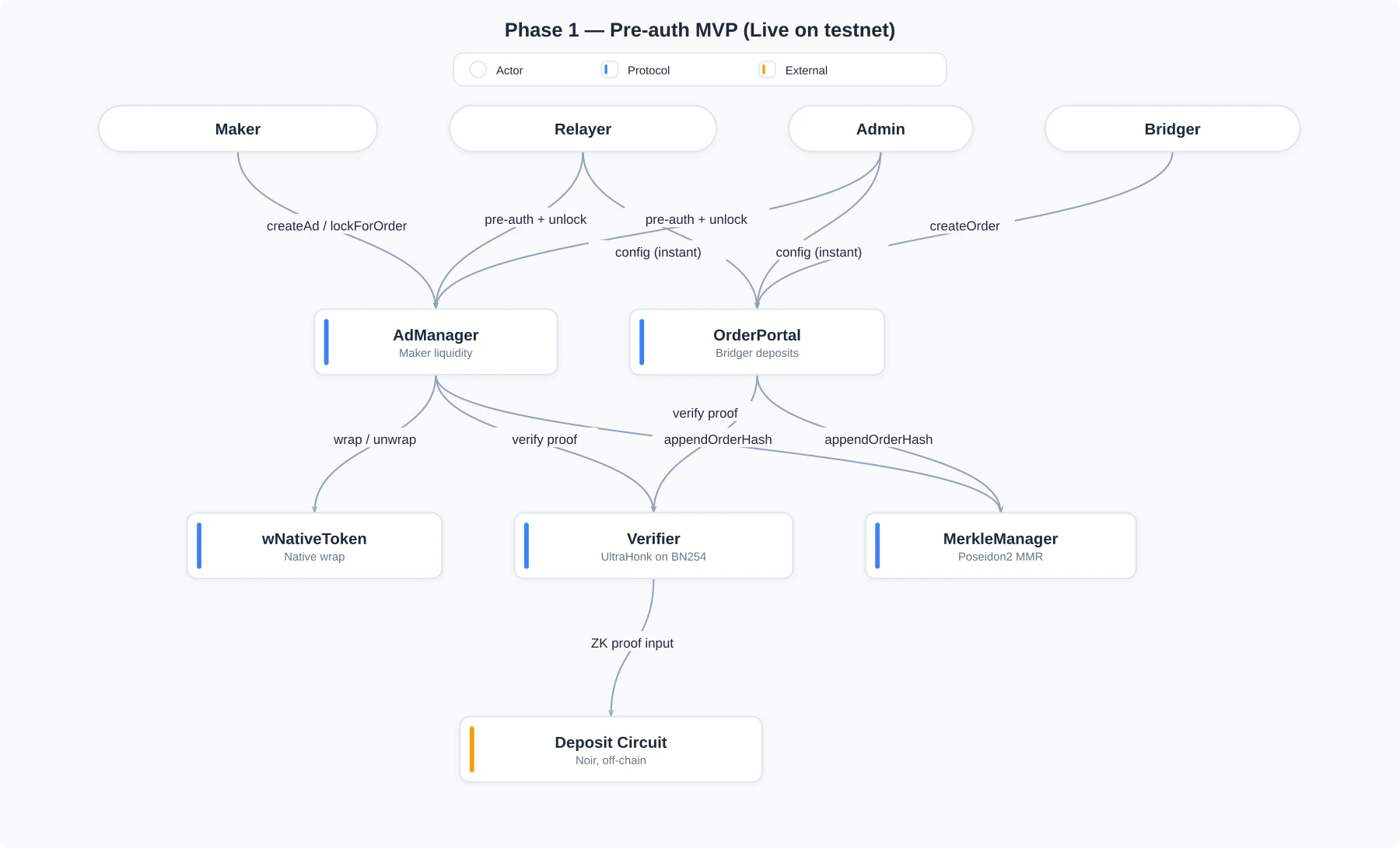
Makers & Bridgers
The two end-user roles.
How it works
The 12-step cross-chain flow as it runs today.
Smart contracts
Function signatures, storage, and deployed testnet addresses.
What’s transitional
Three pieces only exist because the BLS end-state isn’t shipped yet. Phase 2 retires the first, Phase 4 retires the second, and the third is a documentation nuance:- Pre-auth signing. Every state-changing user call carries a manager-signed request hash. A compromised manager key can authorize any user request — though it still cannot redirect funds without a valid ZK proof. Retired in Phase 2.
- Single-key admin on each chain.
setChain,setTokenRoute,setManager, and role grants execute instantly with no delay or multisig. Replaced by multisig + 24h timelock in Phase 4. - Native-token wrapping uses an internal
wNativeTokencontract via a sentinel address. The “native handled directly” story is an aspirational simplification of what the contracts actually do today.
What ships next
Phase 2: BLS Auth & Pre-auth Retirement
Both Maker and Bridger sign the order with BLS once; one
aggregated signature gates both
unlock calls. The pre-auth
path is removed entirely.