
Each phase carries a status marker — ✅ live (deployed on testnet
or mainnet), 🔨 planned (in the current Build Award), or 📅 follow-up
(separately scoped, post-mainnet).
The five phases
Phase 1: Pre-auth MVP
✅ Live on testnet. Bridge transactions settle today between
Sepolia and Stellar Testnet. A ZK proof gates every unlock; a
pre-auth relayer sits in front of every call as transitional
scaffolding.
Phase 2: BLS Auth
🔨 Planned for T1. Stateless BLS12-381 aggregation replaces
the trusted relayer. Maker and bridger each sign once; their
combined signature joins the existing ZK proof at every unlock,
and anyone can submit the call.
Phase 3: Agents & Disputes
🔨 Planned for T2. Soroban custom-account agents act under
scoped policy without holding wallet keys. Order deadlines unlock
permissionless cancel paths; contested orders flow through a
bonded dispute lifecycle.
Phase 4: Mainnet
🔨 Planned for T3. Audit-gated launch on Stellar + Ethereum
mainnet over USDC ↔ USDC. Admin and
ArbiterRole move to
multisigs with a 24-hour timelock; the 0.5% protocol fee turns
on (0.3% to LPs, 0.2% to the protocol).Phase 5: Decentralization & Expansion
📅 Follow-up tranches. DAO governance over the arbiter,
slashable agent stake, more chains, and RWA route partnerships
— all post-mainnet.
End-state architecture (Phase 4)
The diagram below is the shape ProofBridge takes at the end of T3. Earlier-phase diagrams have fewer actors and contracts — click into each phase for the snapshot at that point.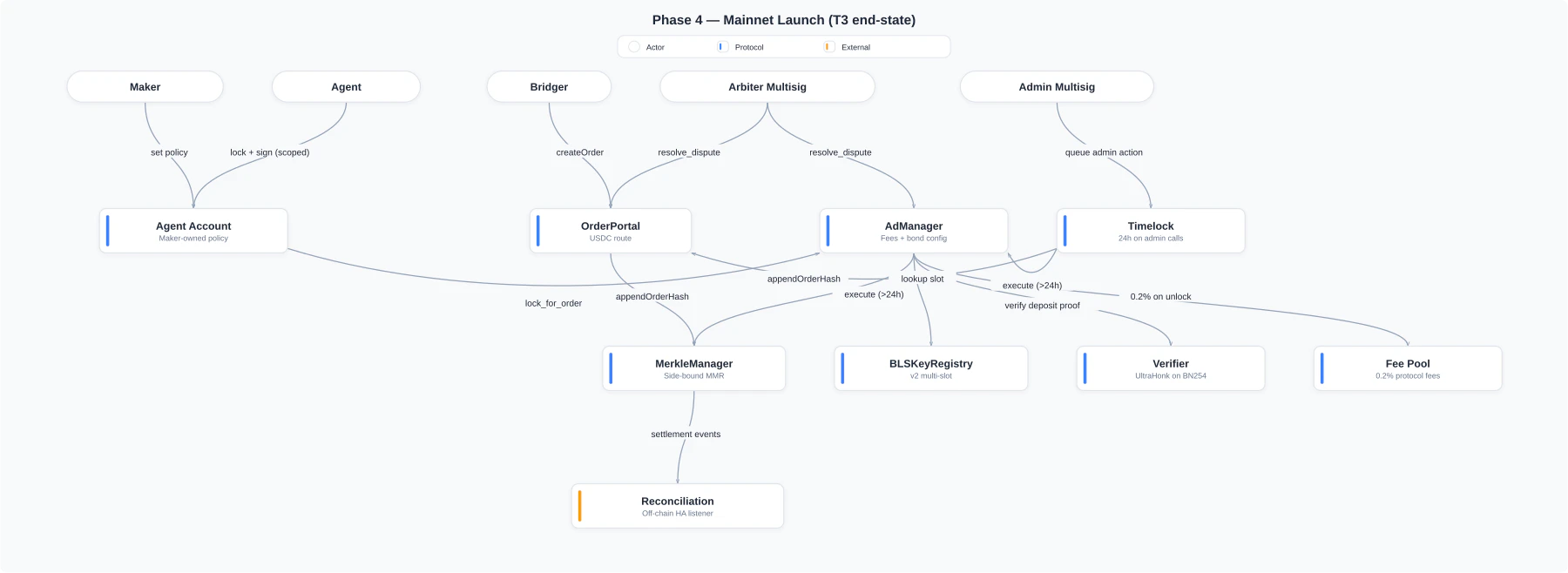
- Top row is actors. Makers, bridgers, and agents are end-users. The admin and arbiter multisigs are the protocol’s remaining trust anchors — bounded, transparent, and on-chain.
- Middle rows are protocol contracts.
AdManagerandOrderPortalare the two escrow contracts users interact with.Agent AccountandTimelockare gateways that gate calls rather than holding funds.MerkleManager,BLSKeyRegistry,Verifier, andFee Poolprovide supporting state. - Bottom is the reconciliation listener — an off-chain HA service that watches both chains and alerts on settlement discrepancies. It has no on-chain authority.
What each phase changes
Click into any phase for the contract-level delta vs the prior
phase and the diagram for that snapshot.
Where to read more
How it works (today)
The current 12-step cross-chain flow as it actually runs on
testnet. Useful baseline before reading the planned phases.
Security model
Trust assumptions in the current phase and how they shrink
through Phases 2–5.
Smart contracts
Per-contract reference: AdManager, OrderPortal, MerkleManager,
Verifier — function signatures and storage.
Roadmap
The chronological / when-does-what view of the same phases.