
🔨 Planned for T1. Replaces the pre-authorization relayer with
on-chain BLS aggregate verification and lands several defensive
contract changes in the same cutover.
Architecture diagram
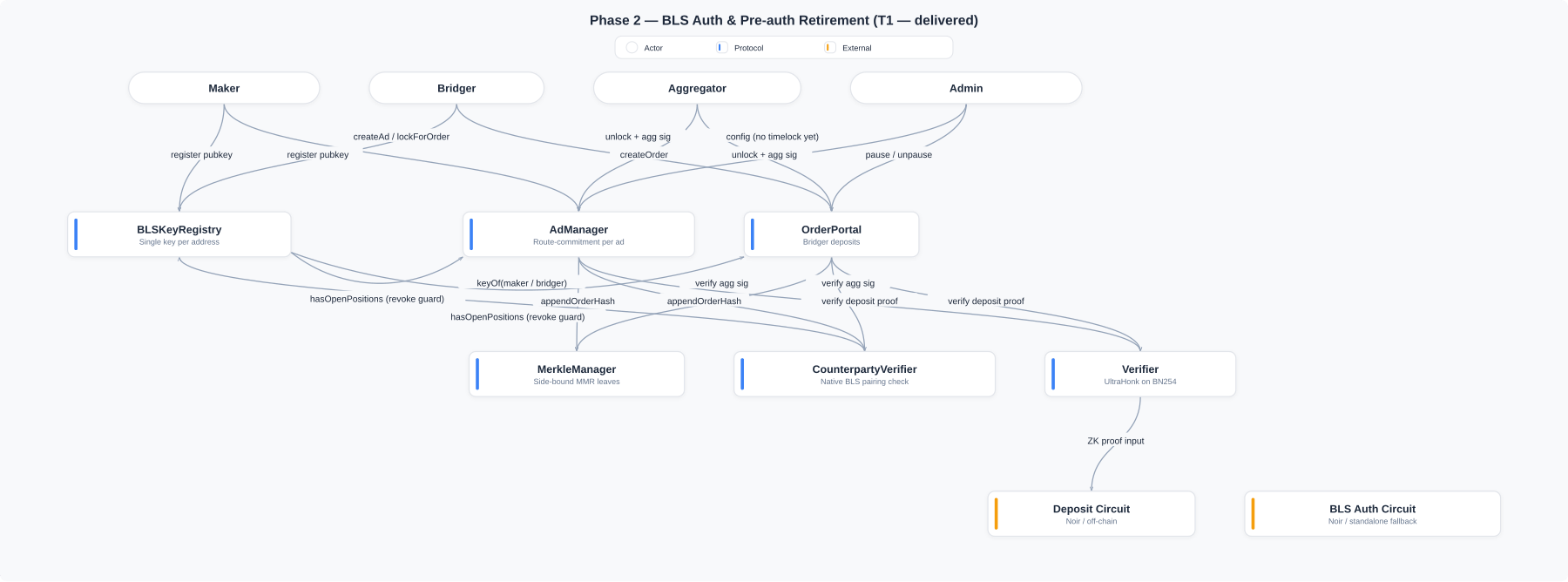
Delta from Phase 1
What changes vs Phase 1:Pre-auth gone
_consumeAuth, managers[], requestTokens[], and the
signature / authToken / timeToExpire parameters are removed
from every state-changing entry point on both AdManager and
OrderPortal.BLS verification on `unlock`
Each
unlock does one native pairing check
(env.crypto().bls12_381().pairing_check on Soroban,
BLS12_PAIRING_CHECK precompile on EVM) against the aggregated
maker + bridger signature.`BLSKeyRegistry`
New contract. Maps each wallet to a registered BLS public key,
with Proof-of-Possession enforced at registration to prevent
rogue-key attacks. Single key per address in T1; a multi-key
upgrade lands in Phase 3.
Route commitment per ad
Every ad pins its
committed_order_token at creation time.
Future admin route changes don’t reach into existing ads —
closes the admin-compromise → fake-token-route drain vector.Side-bound MMR leaves
MerkleManager leaves are now poseidon2(orderHash, sideFlag),
closing the X-1 attack surface where a local-chain leaf could
satisfy a counterpart-chain proof.Pause + 2-step admin
whenNotPaused guard on every state-changing entry point.
Two-step admin transfer (AccessControlDefaultAdminRules on
EVM, pending_admin / accept_admin on Soroban) eliminates the
wrong-address transfer footgun.What gets signed
Both parties sign the same 15-field EIP-712OrderData struct
introduced in Phase 1. The orderHash is byte-identical on both
chains by construction, so one aggregated signature verifies on
either side:
AdManager.unlock and
OrderPortal.unlock.
Curve choices
ProofBridge uses two curves, each chosen for its job:
In T1 the two curves don’t compose at the contract layer. The
deposit proof and the BLS verification are independent gates on
unlock. A combined proof is a long-term optimization tracked in
Phase 5.
T1 also ships a standalone Noir BLS auth circuit as a building
block. It isn’t on the unlock path itself, but later phases use
it for agent attestations and dispute evidence.
What ships next
Phase 3: AI Agents & Dispute Resolution
Soroban custom-account contracts let makers deploy AI agents
under scoped policies. Order
deadline field is added; cancel
and arbiter-driven dispute paths handle stuck or contested
orders. The BLSKeyRegistry upgrades to multi-slot for
single-tx agent rotation.