> ## Documentation Index
> Fetch the complete documentation index at: https://docs.pfbridge.xyz/llms.txt
> Use this file to discover all available pages before exploring further.
# Follow-ups
> Post-mainnet roadmap: DAO governance for the arbiter, agent slashing, additional chains, RWA route partnerships, and protocol-level optimizations.
📅 **Follow-up tranches.** Out of scope for the current SCF Build
Award (T1 + T2 + T3). Two of these — DAO governance and slashing —
are large enough to warrant their own scoped initiatives with
separate funding. The rest are smaller iterations on the launched
protocol.
Phase 5 collects everything that comes after a successful mainnet
launch — two foundational follow-ups plus several scoped iterations.
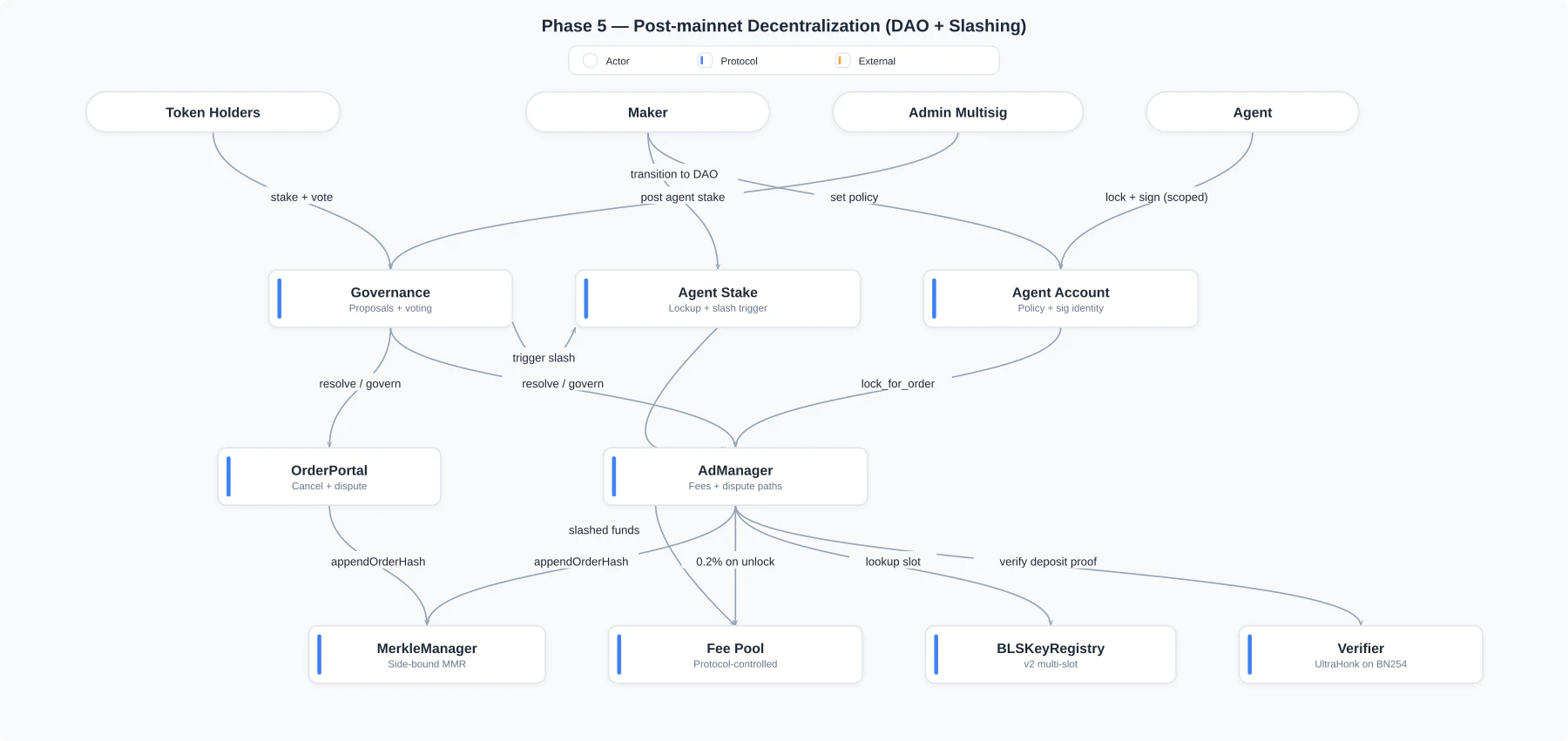
## Architecture diagram (foundational follow-ups)
 ## Delta from Phase 4
What changes vs [Phase 4](/architecture/phase-4-mainnet):
* A new **Token Holders** actor + **Governance** contract take over
from the Phase 4 multisig as the protocol's decision-making layer.
* A new **Agent Stake** contract holds collateral that agents must
post; slashable on confirmed misbehavior.
* The existing Agent Account, contracts, registry, and verifier are
unchanged — Phase 5 layers governance and stake on top rather than
re-architecting the core.
## Foundational A — DAO governance for `ArbiterRole`
Move the `ArbiterRole` from the 5-of-7 multisig (Phase 4 model) to
community-elected, stake-weighted governance. Disputes are resolved by
ProofBridge DAO votes rather than a fixed signer set.
Governance token: supply design, vesting, allocation between team
/ ecosystem / community / treasury. Distribution mechanism and
regulatory + legal review of the structure.
Token contract on each chain. Staking contract — token holders
stake to vote. Governance contract for the proposal lifecycle
(propose → discuss → vote → queue → execute).
The 5-of-7 Phase 4 multisig is retired. `ArbiterRole` becomes
either a governance-controlled signer set (DAO elects N signers
periodically) or DAO-direct (proposal + vote = resolution).
The `protocol_fee_pool` (admin-controlled in Phase 4) transitions
to DAO-controlled. Fee revenue funds the DAO's operations + future
development.
**Why it isn't in the current Build Award.** SCF Build rules
explicitly exclude tokenomics-related spend, so the DAO work isn't
fundable from this envelope. It's also a multi-month initiative
with regulatory dependencies that have to land outside the contract
design itself. And a DAO whose tokens are 100% held by the team is
theatre. Real DAO governance needs distribution to actual
stakeholders, which needs a mainnet-deployed user base whose
contributions are measurable in the first place.
## Foundational B — Agent misbehavior slashing
Add a stake-and-slash penalty layer for agents that misbehave under
their custom-account policy.
Today (post-Phase 3), an agent that signs an invalid trade is bounded
by policy caps, the maker's `revoke_agent()` kill switch, dispute
outcomes (`BridgerForfeit` / `MakerForfeit`), and the per-route
dispute bond. **What slashing adds**: a separate, recoverable
economic penalty beyond "the maker loses the disputed trade".
Each agent's operator posts a stake before being authorized.
Denomination: native, stablecoin, or governance token (depends on
whether DAO governance is live first). Size tied to the agent's
policy ceiling (`max_per_window`) or a flat tier.
Triggered by the arbiter (or DAO post-governance) on
`BridgerForfeit` / `MakerForfeit` outcomes naming the agent's
account. Slash percentage configurable. Slashed funds destination
determined by governance.
14-day cooldown between unstake request and withdrawal. A pending
slash blocks withdrawal until the dispute resolves. Prevents
grief-then-flee patterns.
After a slash, the same operator can re-stake. Slash history is
on-chain for forensic purposes; downstream operators can weigh it
in their trust decisions.
**Why it isn't in the current Build Award.** Pre-mainnet we have zero
data on what agent misbehavior actually looks like. Calibrating
slashing parameters without that data risks two failure modes — too
harsh (no one operates agents) or too lenient (no deterrent, just
extra UX tax). Phase 4's stability data + the first \~3 months of
mainnet operation give a real evidence base.
## Scoped iterations
These ship as small follow-on tranches after mainnet, each config-only
or a modest contract refactor:
Arbitrum, Base, Optimism, Polygon, Starknet, Solana — each is a
contract deployment plus (for non-EVM) circuit work using the
existing T1+T2 contract suite. Add one chain at a time as
ecosystem readiness allows.
Franklin Templeton BENJI, Etherfuse CETES, and other Stellar-native
real-world assets. Route configuration is a `set_token_route`
admin call once a counterpart asset exists on the other chain.
Phase 4's per-route bond config supports this on the storage side;
the missing piece is an oracle integration. Build when justified
by observed dispute behavior.
Phase 4 ships a flat protocol-wide 20/30 fee split. Per-route
configuration is a small refactor of fee storage — useful once
route economics diverge enough to matter.
Phases 1–4 keep BLS auth and the deposit ZK proof as independent
gates. A combined proof is a proof-system optimization motivated
only when L2 batching volumes appear.
## Sequencing
The two foundational follow-ups (A and B) are **not strictly ordered**.
Either order works; ecosystem signal during the post-launch window
(which one users / community ask about more, which surfaces real pain
first) determines priority. The scoped iterations slot in
opportunistically as ecosystem partnerships, route demand, or
operational data justify them.
## Delta from Phase 4
What changes vs [Phase 4](/architecture/phase-4-mainnet):
* A new **Token Holders** actor + **Governance** contract take over
from the Phase 4 multisig as the protocol's decision-making layer.
* A new **Agent Stake** contract holds collateral that agents must
post; slashable on confirmed misbehavior.
* The existing Agent Account, contracts, registry, and verifier are
unchanged — Phase 5 layers governance and stake on top rather than
re-architecting the core.
## Foundational A — DAO governance for `ArbiterRole`
Move the `ArbiterRole` from the 5-of-7 multisig (Phase 4 model) to
community-elected, stake-weighted governance. Disputes are resolved by
ProofBridge DAO votes rather than a fixed signer set.
Governance token: supply design, vesting, allocation between team
/ ecosystem / community / treasury. Distribution mechanism and
regulatory + legal review of the structure.
Token contract on each chain. Staking contract — token holders
stake to vote. Governance contract for the proposal lifecycle
(propose → discuss → vote → queue → execute).
The 5-of-7 Phase 4 multisig is retired. `ArbiterRole` becomes
either a governance-controlled signer set (DAO elects N signers
periodically) or DAO-direct (proposal + vote = resolution).
The `protocol_fee_pool` (admin-controlled in Phase 4) transitions
to DAO-controlled. Fee revenue funds the DAO's operations + future
development.
**Why it isn't in the current Build Award.** SCF Build rules
explicitly exclude tokenomics-related spend, so the DAO work isn't
fundable from this envelope. It's also a multi-month initiative
with regulatory dependencies that have to land outside the contract
design itself. And a DAO whose tokens are 100% held by the team is
theatre. Real DAO governance needs distribution to actual
stakeholders, which needs a mainnet-deployed user base whose
contributions are measurable in the first place.
## Foundational B — Agent misbehavior slashing
Add a stake-and-slash penalty layer for agents that misbehave under
their custom-account policy.
Today (post-Phase 3), an agent that signs an invalid trade is bounded
by policy caps, the maker's `revoke_agent()` kill switch, dispute
outcomes (`BridgerForfeit` / `MakerForfeit`), and the per-route
dispute bond. **What slashing adds**: a separate, recoverable
economic penalty beyond "the maker loses the disputed trade".
Each agent's operator posts a stake before being authorized.
Denomination: native, stablecoin, or governance token (depends on
whether DAO governance is live first). Size tied to the agent's
policy ceiling (`max_per_window`) or a flat tier.
Triggered by the arbiter (or DAO post-governance) on
`BridgerForfeit` / `MakerForfeit` outcomes naming the agent's
account. Slash percentage configurable. Slashed funds destination
determined by governance.
14-day cooldown between unstake request and withdrawal. A pending
slash blocks withdrawal until the dispute resolves. Prevents
grief-then-flee patterns.
After a slash, the same operator can re-stake. Slash history is
on-chain for forensic purposes; downstream operators can weigh it
in their trust decisions.
**Why it isn't in the current Build Award.** Pre-mainnet we have zero
data on what agent misbehavior actually looks like. Calibrating
slashing parameters without that data risks two failure modes — too
harsh (no one operates agents) or too lenient (no deterrent, just
extra UX tax). Phase 4's stability data + the first \~3 months of
mainnet operation give a real evidence base.
## Scoped iterations
These ship as small follow-on tranches after mainnet, each config-only
or a modest contract refactor:
Arbitrum, Base, Optimism, Polygon, Starknet, Solana — each is a
contract deployment plus (for non-EVM) circuit work using the
existing T1+T2 contract suite. Add one chain at a time as
ecosystem readiness allows.
Franklin Templeton BENJI, Etherfuse CETES, and other Stellar-native
real-world assets. Route configuration is a `set_token_route`
admin call once a counterpart asset exists on the other chain.
Phase 4's per-route bond config supports this on the storage side;
the missing piece is an oracle integration. Build when justified
by observed dispute behavior.
Phase 4 ships a flat protocol-wide 20/30 fee split. Per-route
configuration is a small refactor of fee storage — useful once
route economics diverge enough to matter.
Phases 1–4 keep BLS auth and the deposit ZK proof as independent
gates. A combined proof is a proof-system optimization motivated
only when L2 batching volumes appear.
## Sequencing
The two foundational follow-ups (A and B) are **not strictly ordered**.
Either order works; ecosystem signal during the post-launch window
(which one users / community ask about more, which surfaces real pain
first) determines priority. The scoped iterations slot in
opportunistically as ecosystem partnerships, route demand, or
operational data justify them.