> ## Documentation Index
> Fetch the complete documentation index at: https://docs.pfbridge.xyz/llms.txt
> Use this file to discover all available pages before exploring further.
# Agents & Disputes
> Soroban custom-account agents under scoped policies, order deadlines and cancel paths, bonded disputes with arbiter resolution, multi-key BLS registry.
🔨 **Planned for T2.** Builds on Phase 2's BLS-only auth model.
Lands the agent-account model and dispute-handling paths on testnet,
plus the multi-key `BLSKeyRegistry` upgrade.
Phase 3 adds two capabilities held back from earlier phases:
**automated maker liquidity ops under a scoped policy**, and
**dispute paths for stuck or contested orders**. Both build on the
Phase 2 BLS foundation and introduce new on-chain primitives.
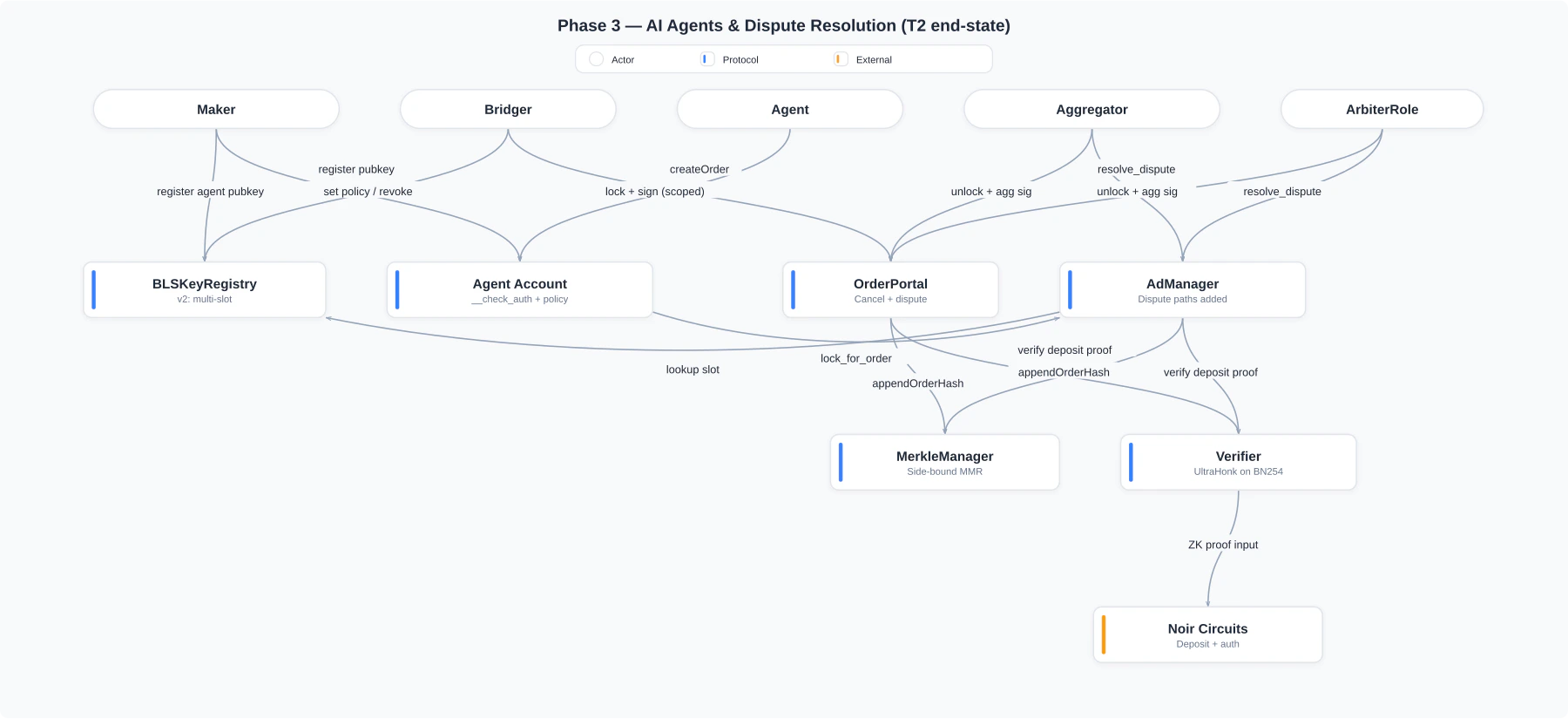
## Architecture diagram
 ## Delta from Phase 2
What changes vs [Phase 2](/architecture/phase-2-bls-auth):
Maker deploys their own contract — Soroban custom account with
`__check_auth`, or per-maker Safe Module on EVM. Stores a policy
table per agent (allowed actions, token whitelist, per-order cap,
rate limit, expiry, revocation flag).
Replaces Phase 2's single-key registry. Each address can hold up
to 5 active key slots with stable monotonic IDs and a `valid_until`
timestamp per slot. `unlock` takes a slot hint so pairing-check
cost stays at one attempt.
The `Order` struct expands from 15 to 16 fields — a signed
`deadline` set per route. Both parties sign the deadline; each
chain validates it's within bounds at create / lock time.
`cancel_order` (OrderPortal) and `cancel_lock` (AdManager) are
permissionless after deadline. Refunds via pull-payment escrow,
unwinds maker `ad.locked` back into ad balance.
`dispute()` posts a bond and moves the order into `Disputed`.
`respond_to_dispute()` lets the counterparty add evidence.
`resolve_dispute()` pays out per a discrete `DisputeOutcome` enum.
A new role holds dispute-resolution authority. In T2 this equals
the protocol admin; the role moves to its own multisig in
[Phase 4](/architecture/phase-4-mainnet).
## How agents work
A maker who wants automated liquidity operations:
Soroban: deploy a custom-account contract that implements
`__check_auth`. EVM: deploy a per-maker Safe + Safe Module. Either
way, the maker is the owner.
Owner calls `set_policy(agent_pubkey, policy)` with allowed actions,
token whitelist, per-order cap, rate limit, expiry, and revocation
flag.
Owner registers the agent's BLS public key against the Agent
Account's address. The agent becomes the maker's BLS-signing
identity for trades within policy.
Maker creates ads with `ad_creator = agent_account_address`. The
agent can call `lock_for_order` and produce BLS signatures within
policy bounds — without ever holding the maker's wallet key.
To replace an agent (compromise, software change), the maker adds
a new BLS key slot and sets `valid_until` on the old slot. No need
to close ads or migrate liquidity.
Agents cannot initiate disputes, modify their own policy, touch funds
outside the maker's ads, or operate beyond `valid_until` / rate-limit
ceilings.
## How disputes work
The order lifecycle expands from `None → Open → Filled` to include two
new branches:
```text theme={null}
None → Open → Filled (happy path, unchanged from Phase 2)
Open → Cancelled (timeout-based unwind after deadline)
Open → Disputed → Resolved (challenge path before deadline)
```
Disputes are raisable on either chain while the order is `Open` and
**before** the route's deadline. After deadline, the cancel path takes
over — no arbiter needed. The bond + arbiter judgement deters frivolous
disputes; the system self-regulates on incentives.
`DisputeOutcome` covers the four real-world resolutions:
| Outcome | Source side (OrderPortal) | Destination side (AdManager) |
| ---------------- | ------------------------------------- | ----------------------------------------------- |
| `MutualRefund` | Bridger refunded | `ad.locked -= ad_amount` (back into ad balance) |
| `TradeProceeds` | Bridger's deposit → maker's recipient | Maker's locked balance → bridger's recipient |
| `BridgerForfeit` | Bridger's deposit → maker (forfeit) | `ad.locked -= ad_amount` |
| `MakerForfeit` | Bridger refunded | Maker's locked balance → bridger's recipient |
The arbiter is responsible for issuing matching outcomes on both
chains. Off-chain coordination keeps the two halves consistent.
## Using the BLS auth circuit in disputes
The standalone Noir BLS auth circuit from
[Phase 2](/architecture/phase-2-bls-auth) finds its first real use
here. A counterparty defending a dispute can submit a ZK proof
attesting "I had a valid aggregated BLS authorization for this trade"
without publishing the raw aggregated signature off-chain. The
existing UltraHonk verifier checks the proof on-chain, and the
arbiter sees a portable cryptographic claim instead of asking for
screenshots.
## What ships next
Stellar + Ethereum mainnet deploy, admin and ArbiterRole both hand
off to multisigs, 24-hour timelock on critical admin actions, protocol
fee mechanism, USDC ↔ USDC launch route, cross-chain reconciliation
listener.
## Delta from Phase 2
What changes vs [Phase 2](/architecture/phase-2-bls-auth):
Maker deploys their own contract — Soroban custom account with
`__check_auth`, or per-maker Safe Module on EVM. Stores a policy
table per agent (allowed actions, token whitelist, per-order cap,
rate limit, expiry, revocation flag).
Replaces Phase 2's single-key registry. Each address can hold up
to 5 active key slots with stable monotonic IDs and a `valid_until`
timestamp per slot. `unlock` takes a slot hint so pairing-check
cost stays at one attempt.
The `Order` struct expands from 15 to 16 fields — a signed
`deadline` set per route. Both parties sign the deadline; each
chain validates it's within bounds at create / lock time.
`cancel_order` (OrderPortal) and `cancel_lock` (AdManager) are
permissionless after deadline. Refunds via pull-payment escrow,
unwinds maker `ad.locked` back into ad balance.
`dispute()` posts a bond and moves the order into `Disputed`.
`respond_to_dispute()` lets the counterparty add evidence.
`resolve_dispute()` pays out per a discrete `DisputeOutcome` enum.
A new role holds dispute-resolution authority. In T2 this equals
the protocol admin; the role moves to its own multisig in
[Phase 4](/architecture/phase-4-mainnet).
## How agents work
A maker who wants automated liquidity operations:
Soroban: deploy a custom-account contract that implements
`__check_auth`. EVM: deploy a per-maker Safe + Safe Module. Either
way, the maker is the owner.
Owner calls `set_policy(agent_pubkey, policy)` with allowed actions,
token whitelist, per-order cap, rate limit, expiry, and revocation
flag.
Owner registers the agent's BLS public key against the Agent
Account's address. The agent becomes the maker's BLS-signing
identity for trades within policy.
Maker creates ads with `ad_creator = agent_account_address`. The
agent can call `lock_for_order` and produce BLS signatures within
policy bounds — without ever holding the maker's wallet key.
To replace an agent (compromise, software change), the maker adds
a new BLS key slot and sets `valid_until` on the old slot. No need
to close ads or migrate liquidity.
Agents cannot initiate disputes, modify their own policy, touch funds
outside the maker's ads, or operate beyond `valid_until` / rate-limit
ceilings.
## How disputes work
The order lifecycle expands from `None → Open → Filled` to include two
new branches:
```text theme={null}
None → Open → Filled (happy path, unchanged from Phase 2)
Open → Cancelled (timeout-based unwind after deadline)
Open → Disputed → Resolved (challenge path before deadline)
```
Disputes are raisable on either chain while the order is `Open` and
**before** the route's deadline. After deadline, the cancel path takes
over — no arbiter needed. The bond + arbiter judgement deters frivolous
disputes; the system self-regulates on incentives.
`DisputeOutcome` covers the four real-world resolutions:
| Outcome | Source side (OrderPortal) | Destination side (AdManager) |
| ---------------- | ------------------------------------- | ----------------------------------------------- |
| `MutualRefund` | Bridger refunded | `ad.locked -= ad_amount` (back into ad balance) |
| `TradeProceeds` | Bridger's deposit → maker's recipient | Maker's locked balance → bridger's recipient |
| `BridgerForfeit` | Bridger's deposit → maker (forfeit) | `ad.locked -= ad_amount` |
| `MakerForfeit` | Bridger refunded | Maker's locked balance → bridger's recipient |
The arbiter is responsible for issuing matching outcomes on both
chains. Off-chain coordination keeps the two halves consistent.
## Using the BLS auth circuit in disputes
The standalone Noir BLS auth circuit from
[Phase 2](/architecture/phase-2-bls-auth) finds its first real use
here. A counterparty defending a dispute can submit a ZK proof
attesting "I had a valid aggregated BLS authorization for this trade"
without publishing the raw aggregated signature off-chain. The
existing UltraHonk verifier checks the proof on-chain, and the
arbiter sees a portable cryptographic claim instead of asking for
screenshots.
## What ships next
Stellar + Ethereum mainnet deploy, admin and ArbiterRole both hand
off to multisigs, 24-hour timelock on critical admin actions, protocol
fee mechanism, USDC ↔ USDC launch route, cross-chain reconciliation
listener.